Mental clarity
How to Organize Your Thoughts When Everything Feels Like Too Much
By ClarityOne Editorial
Sometimes the problem isn’t that you don’t know what you’re thinking. It’s that you’re thinking about too many things at the same time.
A deadline. A conversation from yesterday. Something you need to decide. Something you forgot to do. Something that might happen next week.
When everything occupies the same mental space, even simple decisions can start feeling complicated.
Organizing your thoughts isn’t about forcing your mind to become empty. It’s about giving different thoughts somewhere to go — so you can see what actually deserves your attention.
The short answer
If your thoughts feel scattered, don’t try to solve everything inside your head. Start by getting the thoughts out, separating facts from interpretations, grouping related concerns, identifying what you can control, and choosing one thing that deserves your attention first.
- 1.Capture everything.
- 2.Separate facts from interpretations.
- 3.Group related thoughts.
- 4.Identify what you can control.
- 5.Decide what matters now.
- 6.Turn one thought into one next action.
Why thoughts can feel harder to organize than they actually are
At any given moment your mind may be holding several unfinished things at once: a task you haven’t started, a decision you haven’t made, a worry you haven’t resolved, a memory you keep returning to, a conversation you’re still processing, an idea you don’t want to lose, and a future possibility you can’t plan for yet.
These aren’t the same type of thought. A task needs a step. A decision needs information. A worry may need nothing at all. But internally they can feel identical, because each one is simply asking for attention.
Imagine putting work documents, photographs, shopping lists, letters and receipts into one drawer. The problem isn’t necessarily how much is inside. The problem is that nothing has been separated.
Thoughts behave similarly. Once things of different kinds share one space, finding anything means going through everything. Organizing your thoughts is mostly the work of separating them — not thinking harder about them.
Step 1: Get the thoughts out before trying to organize them
Trying to sort thoughts while they are still in your head means doing two jobs at once: holding everything and arranging it. Externalizing — putting thoughts somewhere outside your mind — removes the first job.
Open whatever is nearest: paper, a notes app, a blank document, or a voice note. Write down everything currently taking up mental space. No categories yet. No perfect sentences. No prioritizing.
I need to finish the presentation.
I still feel weird about what she said yesterday.
I haven’t booked my flight.
I’m worried I’m making the wrong decision.
I need to reply to three people.
I don’t know whether I’m doing enough.
The goal isn’t to solve these thoughts yet. It’s to stop requiring your mind to hold all of them simultaneously. This step is often called a brain dump, and it works precisely because it asks nothing of you except getting things down. If you’d rather do it with help, here’s what ClarityOne is.
Step 2: Separate facts from interpretations
Once things are written down, you’ll usually notice that some lines describe what happened and others describe what you think it means. Both feel equally true while they’re in your head.
Fact
They haven't replied since yesterday.
Interpretation
They're upset with me.
Fact
I have two assignments due this week.
Interpretation
I'm going to fall behind on everything.
Interpretations aren’t necessarily wrong. Sometimes they turn out to be exactly right. The purpose of separating them is simply to recognize the difference between what you know and what your mind is trying to explain.
A single question is usually enough for this step: What do I actually know here?
Step 3: Put similar thoughts together
Grouping turns one large pile into a few smaller ones. You don’t need a system. A handful of plain headings does the job:
- Things I need to do
- Things I need to decide
- Things I'm worried about
- Things I can't control
- Things I want to understand
- Things I don't need to deal with today
Categories don’t need to be perfect, and some thoughts will belong in two places. That’s fine. Their only purpose is to reduce one overwhelming pile into groups small enough to look at individually.
When writing everything down still leaves you stuck
Sometimes getting thoughts out is enough. Sometimes it isn’t. You may have written everything down and still be looking at the page thinking: Okay… but what actually matters here?
ClarityOne was built for that moment. It’s an AI-powered mental clarity app where you can unload what’s on your mind in your own words and interactively work through the mental noise toward a clearer direction. Unlike a blank notes page, it can respond to what you’ve written and help you explore what’s actually competing for your attention.
How ClarityOne fits into the process
- 1. Tell it what’s on your mind.
- 2. Work through the thoughts in a Clarity Session.
- 3. See what stands out — the Mental Noise Score shows how crowded your thinking felt before and after.
- 4. Leave with clearer direction and one next step.
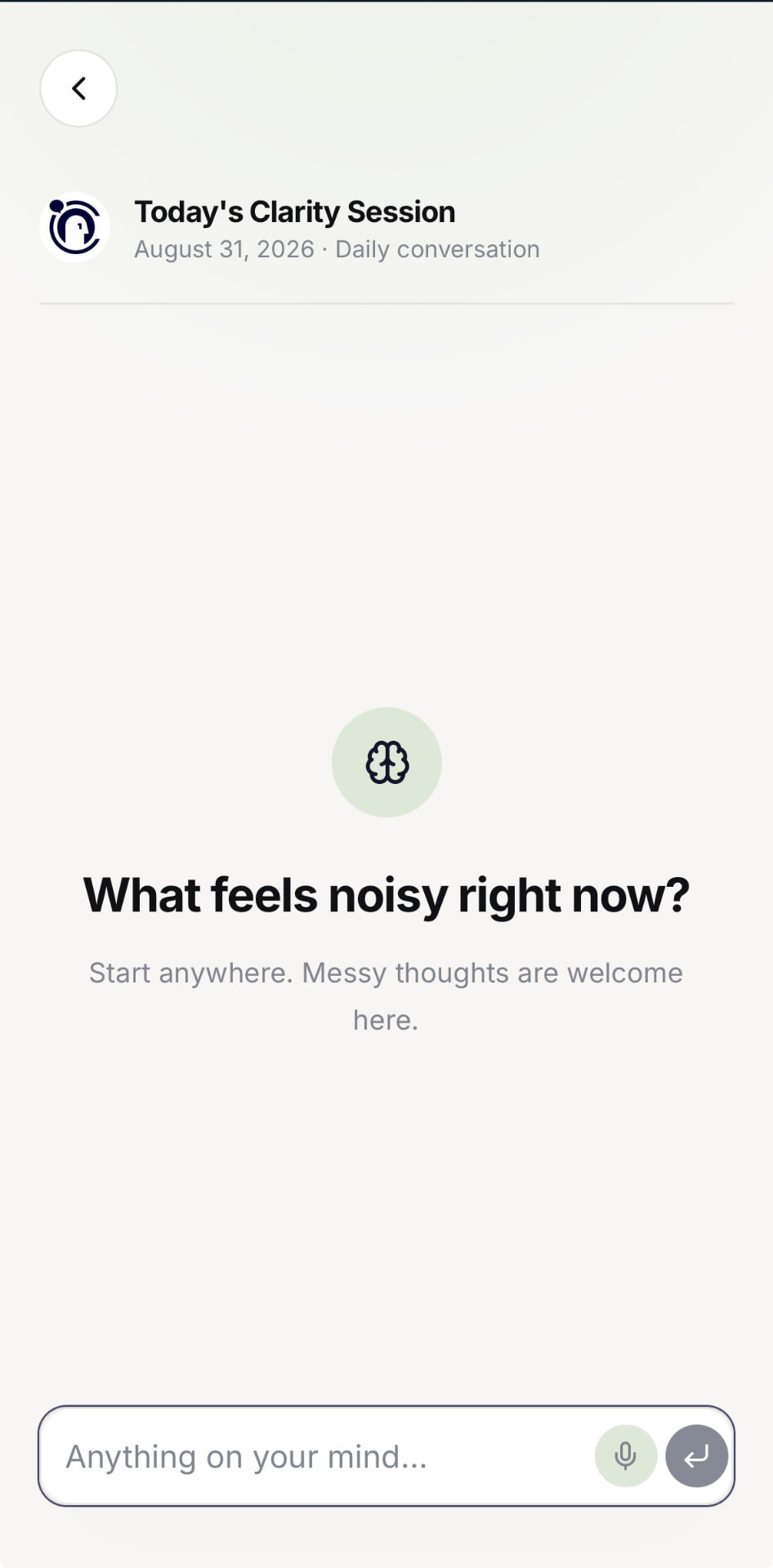
You don’t need to organize your thoughts before you start.
Try ClarityOneClarityOne is designed for mental clarity and self-reflection. It is not therapy or a replacement for professional mental-health care.
Step 4: Separate what you can influence from what you can’t
I can influence
- Sending the message
- Starting the assignment
- Asking the question
- Making the appointment
- Deciding what I do next
I can’t fully control
- Someone’s reaction
- Whether everyone agrees with me
- What already happened
- Every possible future outcome
- What another person thinks
A surprising amount of mental energy can be spent trying to solve things that don’t currently have an action attached to them.
The point isn’t to stop caring. It’s to know where your effort can actually go.
Step 5: Find the thought underneath the thoughts
Several separate-looking thoughts are often expressions of one underlying question. When that happens, answering the question does more than answering each thought individually.
- I should work harder.
- I'm falling behind.
- Everyone else seems ahead.
- I don't know what I should focus on.
Possible underlying question
Am I spending my time on the right things?
- Why did they say that?
- Should I message them?
- Did I do something wrong?
- What if they're losing interest?
Possible underlying question
Has something changed between us?
These are illustrative examples, not psychological diagnoses. Your underlying question may be completely different, and finding it is a matter of noticing what your thoughts keep circling rather than applying a formula.
If I could get clarity on only one thing here, what would I choose?
Step 6: Decide what deserves attention now
Four qualities often get treated as one: important, urgent, emotionally loud and actionable. They overlap, but they aren’t identical. A worry can be loud and not actionable. An email can be urgent and not important. A decision can be important and quiet enough that you keep postponing it.
Five questions usually separate them:
- Does this require action today?
- Can I actually do something about it?
- Will dealing with it make something else easier?
- Am I repeatedly returning to it because it's unresolved?
- What happens if I leave it until tomorrow?
Then choose one priority. Not five.
Step 7: Turn clarity into one next action
Organizing thoughts shouldn’t end with a beautifully categorized list. It should end with less uncertainty about what happens next. The difference is usually specificity.
Figure out university.
Write down the three courses I'm deciding between.
Fix relationship.
Ask whether we can talk tonight.
Get my life organized.
Choose the three things that actually need to happen this week.
Stop overthinking.
Write down the decision I'm actually trying to make.
Make the next action small enough that you know exactly what doing it looks like. If you can picture yourself starting it, it’s specific enough.
A 5-minute thought-organizing exercise
If you want to try all of this now, this takes five minutes and needs nothing but something to write with.
Minute 1
Write everything currently occupying your mind.
Minute 2
Mark each thought: T = task, D = decision, W = worry, Q = question, I = idea.
Minute 3
Circle what you can actually influence.
Minute 4
Choose the one thought that would create the most clarity if addressed.
Minute 5
Write one next action.
You don’t need to organize your entire life in five minutes. You only need to make the next few minutes clearer.
What if the same thought keeps coming back?
Writing something down once doesn’t always make it settle. That’s common, and it usually means something about the thought is still open rather than that you did the exercise wrong.
- The decision remains unresolved.
- There is information you don't have yet.
- The situation matters to you emotionally.
- There is no clear next action.
- Something about it is outside your control.
- You're still trying to understand what happened.
When a thought keeps returning, these questions can help locate what’s open:
What am I actually trying to answer?
Is there information I’m waiting for?
Is there an action available?
Am I trying to control an outcome I can’t control?
Would talking to someone help?
If this is a familiar pattern rather than a one-off, there’s a longer piece on when your thoughts keep going in circles.
Different ways to organize your thoughts
No single method suits every person or every moment. Most people end up using two or three depending on what they need.
Paper
Best when: You want zero distractions and the freedom to draw, cross things out and connect ideas visually.
Notes app
Best when: You need something fast and always available, wherever you are.
Voice notes
Best when: Speaking feels easier than writing, or your hands are busy.
Journaling
Best when: You want deeper reflection and a record of your experiences over time.
Talking to someone
Best when: You want another person's perspective, or support rather than a system.
AI-assisted reflection
Best when: You want an interactive tool that helps you work through thoughts rather than only store them.
Questions about organizing your thoughts
- How do I organize my thoughts when overwhelmed?
- Get everything out of your head first, in any order. Then separate facts from interpretations, group similar thoughts together, mark what you can actually influence, and choose one thing to act on. Overwhelm usually comes from holding everything at once, not from the number of items themselves.
- Why do my thoughts feel scattered?
- Because unfinished thoughts of different kinds — tasks, decisions, worries, questions, ideas — tend to occupy the same mental space until they are separated. Nothing has been sorted, so everything keeps asking for attention at the same volume.
- How do I organize my thoughts before making a decision?
- Write the decision as a single question, list what you actually know, list what you are assuming, and note what information is still missing. Deciding often gets easier once the question is separate from everything attached to it.
- Should I write down everything I'm thinking?
- It helps to write more than feels necessary, without editing. The point is not a tidy list; it is to stop requiring your mind to hold every item simultaneously. You can sort afterwards.
- How do I prioritize when everything feels important?
- Ask which items require action today, which you can actually do something about, and which would make other things easier once handled. Emotional loudness and genuine urgency are not the same thing. Choose one priority rather than five.
- What's the difference between a brain dump and organizing your thoughts?
- A brain dump is the capture step: getting everything out without structure. Organizing your thoughts is what happens afterwards — separating, grouping, prioritizing and deciding on a next action.
- Can journaling help organize thoughts?
- For many people, yes. Journaling gives thoughts a place to go and creates a record you can return to, which can be useful for reflection over time. It is less suited to moments when you need to reach a decision quickly.
- Can AI help organize my thoughts?
- It can, when you want something that responds rather than only stores. An AI tool can ask follow-up questions, reflect back what seems central and help separate concerns that are tangled together. It does not replace your own judgment about what matters.
- Do I need an app to organize my thoughts?
- No. Paper, a notes app, a journal, a voice memo or a conversation with someone you trust can all work well, and for most people one of those is enough. An interactive tool is only worth considering if you want help working through what you have written rather than just capturing it.
In closing
Your mind doesn’t need to be empty to feel clearer.
Sometimes clarity is simply knowing what’s happening, what matters, what you can influence, and what you’ll do next.
Start there.