Overthinking & mental clarity
When your mind keeps going in circles, give it somewhere to go.
Overthinking can make one thought turn into ten. A decision becomes a list of possibilities. A conversation gets replayed. Everything starts competing for attention at once.
ClarityOne gives you a place to put those thoughts into words and work through what’s actually taking up your mental space.
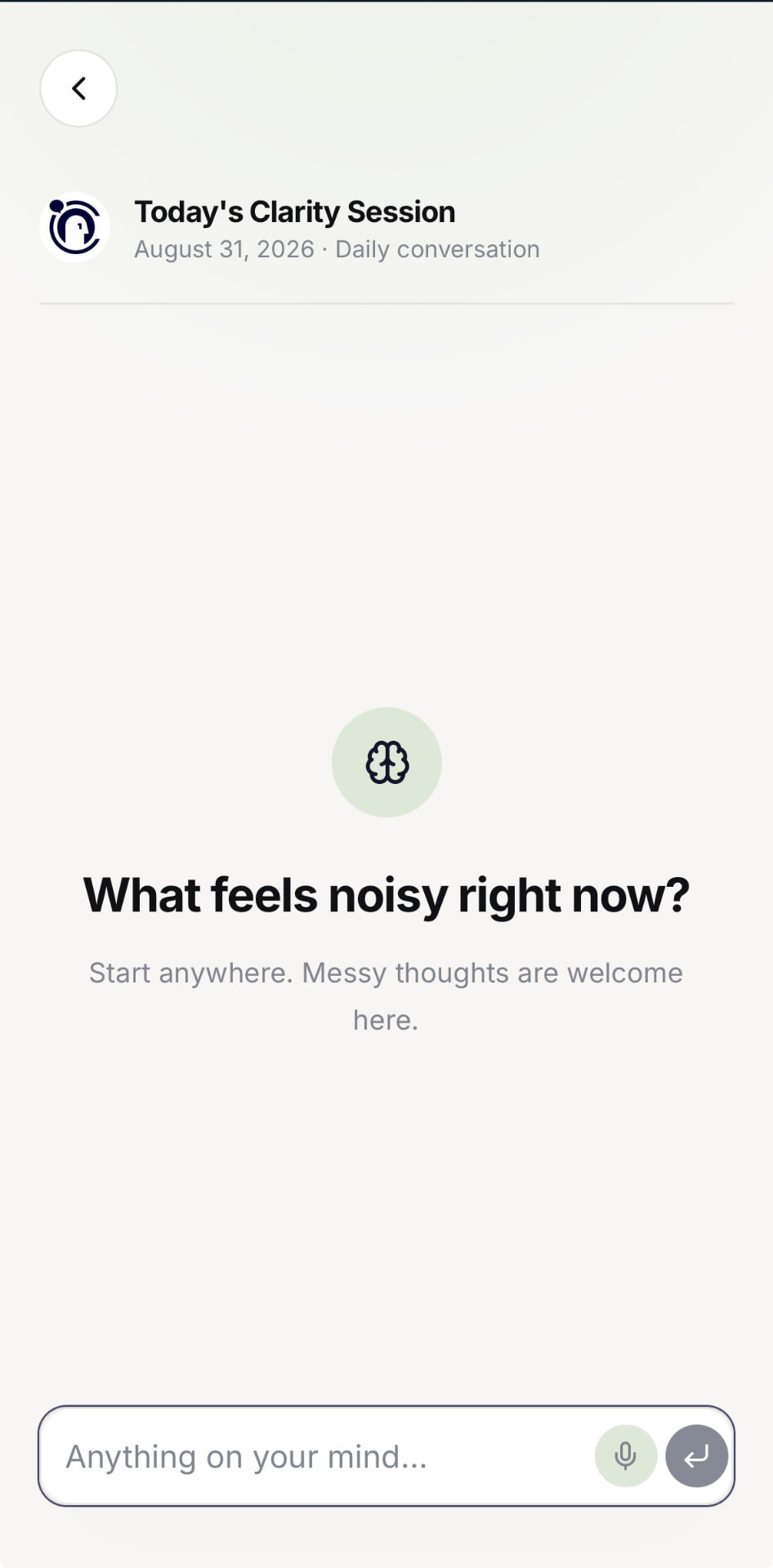
What does overthinking actually feel like?
It rarely announces itself. It looks like replaying the same conversation for the third time today. Considering every possible outcome of a decision you haven’t made yet — or questioning one you already have. Jumping between several unfinished thoughts and finishing none of them.
Sometimes it’s knowing that something matters but having no idea what to do about it. Sometimes it’s several problems competing for attention at the same volume, so none of them gets any.
“Overthinking” is an everyday word, and it describes different experiences for different people. It isn’t a diagnosis, and this page doesn’t treat it as one. What these moments tend to share is a sense of mental crowding: a lot of thought, not much movement.
Sometimes the problem isn’t having too many thoughts. It’s not knowing which one deserves your attention.
Why do we keep returning to the same thoughts?
Repetitive thinking can happen for many reasons, and no single explanation fits everyone. For some people it shows up around uncertainty — a situation without a clear answer. For others it gathers around unresolved decisions, or around wanting control over an outcome that isn’t fully theirs to control.
Emotionally important situations tend to get more mental airtime. Competing priorities can too, because each one keeps asking to be considered. A fear of making the wrong choice is another common possibility: the thinking continues because deciding feels riskier than deliberating.
Whatever the reason, a loop is usually a sign that a thought hasn’t found a place to land. That’s the part a practical exercise can sometimes help with.
When everything feels important, separate the thoughts.
You don’t need any app for this. A piece of paper works. The idea is to stop treating the noise as one big problem and give each part of it its own question.
- 01
What's actually happening?
Write the situation without trying to solve it. Just the facts of where you are.
- 02
What keeps returning?
Identify the thought you find yourself repeatedly coming back to, even when you try to think about something else.
- 03
What are you trying to figure out?
Turn the mental loop into a question. Loops spin; questions can be worked on.
- 04
What can you influence?
Separate what requires action from what is outside your control.
- 05
What deserves attention now?
Choose one thing rather than trying to resolve everything simultaneously.
If you’ve ever tried using a brain dump to clear your head, this exercise is a way to go one step further: not just getting the thoughts out, but sorting them once they are.
What if you don’t want to untangle it alone?
Sometimes you know your thoughts are tangled, but turning them into a neat list isn’t realistic. The exercise above works well on a clear evening. It works less well when your head is already full. For a calmer moment, there’s a longer guide on how to organize your thoughts step by step, and a plain explanation of how ClarityOne works.
That’s where ClarityOne comes in. ClarityOne is an AI-powered mental clarity app designed to give you somewhere to unload what’s on your mind in your own words. Instead of requiring you to organize everything first, the experience helps you work through the mental noise and move toward a clearer understanding of what deserves your attention.
It’s a self-reflection tool, not a mental-health service. It doesn’t diagnose anything, and it doesn’t replace professional care.
You don’t need to know where to start.
- 01
Say what's on your mind
Start messy. Explain the situation exactly as it exists in your head, typed or spoken.
- 02
Work through it
Use a Clarity Session to explore the thoughts competing for your attention.
- 03
See what stands out
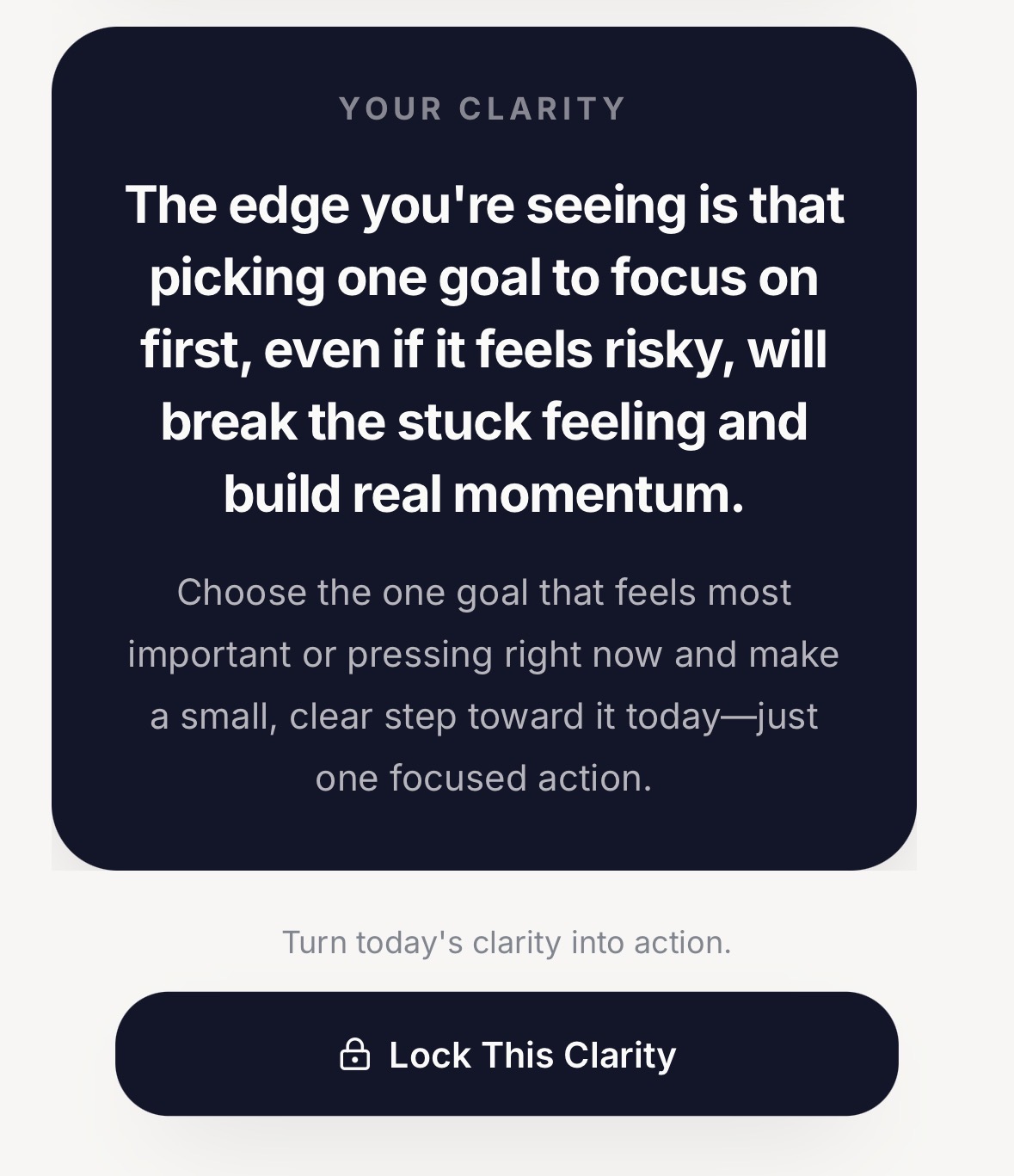
ClarityOne helps you move from a collection of thoughts toward a clearer understanding of what matters.
- 04
Move forward
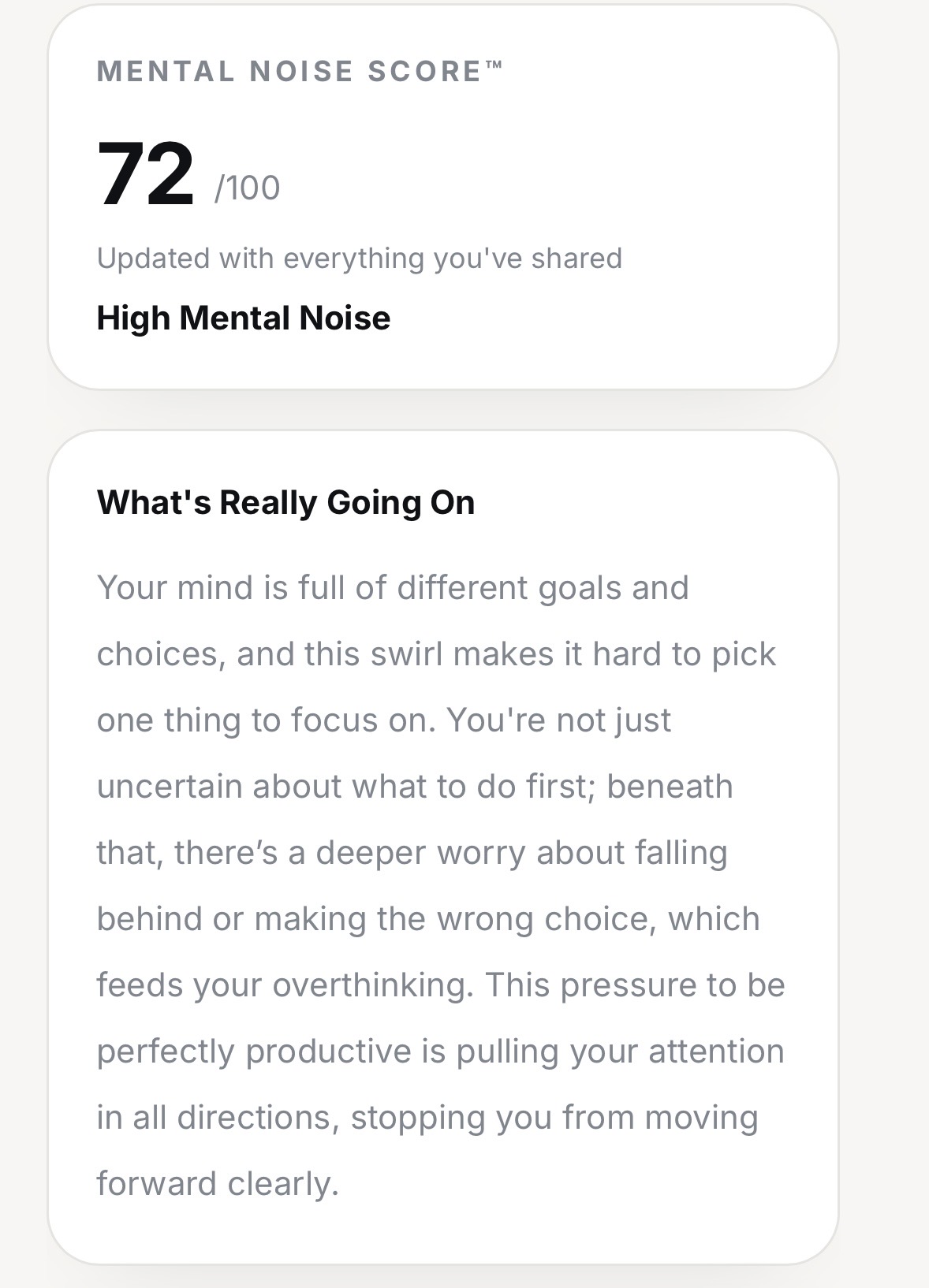
Finish with more direction than you started with. The Mental Noise Score shows how crowded your thinking felt before and after a session, so you can see the shift instead of just hoping for one. Pick one next step and give it a small block of time — one small move beats a perfect plan still spinning in your head.
Overthinking doesn’t always look the same.
Illustrative examples — not real users
Example — A decision
“I've been thinking about whether I should take this opportunity for three days. Every time I decide yes, I think of another reason to say no.”
Here the actual decision is buried under every imagined consequence of it. Separating the choice itself from the surrounding thoughts can make it smaller and easier to face.
Example — A conversation
“They replied differently than usual yesterday and now I keep wondering whether I said something wrong.”
A fact, an interpretation and an unanswered question are mixed together in this thought. Untangling which is which changes how much weight it should carry.
Example — Too much at once
“I need to study, reply to people, finish something for work and make a decision about next week. I'm doing none of it because I keep thinking about all of it.”
When priorities compete at the same volume, it becomes difficult to identify where to start. Giving each thought its own space can make the starting point visible.
There isn’t one right way to work through your thoughts.
Different tools suit different moments, and none of them is universally better.
- Writing a list
- Useful when the tasks are already clear and primarily need prioritization.
- Journaling
- Useful when you want space for longer-form reflection and recording experiences over time.
- Talking to someone
- Useful when you want another person’s perspective, emotional support, or professional help where appropriate.
- ClarityOne
- Useful when you want somewhere to unload scattered thoughts and interactively work toward understanding what deserves your attention.
When your thoughts need somewhere to go
- When you're stuck between several decisions.
- When you keep replaying the same situation.
- When everything feels equally urgent.
- When you know something is bothering you but can't explain exactly what.
- When work, relationships, study and personal thoughts are competing at once.
- When you simply want to understand what's taking up your mental space.
Why ClarityOne
Most tools ask you to organize your thoughts before they can help. ClarityOne is built for the opposite situation — when your thinking feels crowded and you don’t know where to start.
Built for loops, not lists
Repetitive thinking isn’t a task-management problem. ClarityOne is designed to help you step out of the loop, not just record it.
Start mid-thought
There’s no blank page to get right. Explain the situation exactly as it exists in your head — typed or spoken — and the session works from there.
From noise to next step
Sessions are built to end with more direction than you started with: what matters most right now, and one small, doable step toward it.
Honest about what it is
ClarityOne is a mental clarity and self-reflection tool — not therapy, not a medical service. It’s a quiet iOS app for working through crowded thinking.
Simple pricing
ClarityOne is free to download. ClarityOne Premium unlocks the full experience, and the yearly plan starts with a one-week free trial.
Monthly
$5/month
Cancel anytime.
Yearly
Best value$30/year
7-day free trial included. Works out to $2.50/month.
Subscriptions are managed securely through the App Store. You can cancel or switch plans anytime in your App Store settings, and the free trial never converts without your choice to continue.

Questions people ask about overthinking
Why do I overthink everything?
There usually isn't one reason. Repetitive thinking can come from uncertainty, unresolved decisions, situations that matter to you, or wanting more control over an outcome than you actually have. It varies from person to person, and it isn't a diagnosis or a character flaw.
How can I organize my thoughts when I'm overwhelmed?
Start by getting them out of your head in any order, then separate them: what is actually happening, what you keep returning to, and what is within your influence. Trying to solve everything at once tends to keep the loop going; choosing one thing usually doesn't.
Does writing your thoughts down help with overthinking?
For many people, yes. Externalizing thoughts — sometimes called a brain dump — stops you from holding every item in your head at once, and seeing them written down often makes the pile look more manageable. It's a starting point rather than a complete answer for everyone.
Can AI help me organize my thoughts?
AI can help by responding to what you wrote: asking follow-up questions, reflecting back what seems central and helping you separate concerns that are tangled together. It works best as a thinking partner for a specific moment, not as a replacement for your own judgment.
What is an app for overthinking?
It's a tool designed for moments when your thinking feels crowded or repetitive. Some focus on capture, like notes and journals. Others, like ClarityOne, focus on helping you work through what you wrote and move toward a clearer sense of what deserves your attention.
How is ClarityOne different from a journal?
A journal preserves what you wrote so you can return to it. ClarityOne responds to what you wrote — a session is designed to help you work through the mental noise in the moment and finish with more direction than you started with.
Is ClarityOne a mental-health app?
ClarityOne is a mental clarity and self-reflection tool. It doesn't diagnose, treat or prevent any condition, and it isn't a medical service.
Does ClarityOne replace therapy?
No. ClarityOne is designed for mental clarity and self-reflection. It is not therapy and does not replace professional mental-health care. If you're struggling, please speak with a qualified professional.
How much does ClarityOne cost?
ClarityOne Premium is $5 per month or $30 per year. The yearly plan starts with a one-week free trial, and you can cancel anytime through your App Store subscription settings.
Is there a free trial?
Yes. The yearly plan starts with a 7-day free trial, so you can try ClarityOne Premium before deciding whether it's right for you.
More questions? See the ClarityOne support page, or read about the app on the ClarityOne home page.
Start with the thought you keep coming back to.
You don’t need to have it figured out before you begin.